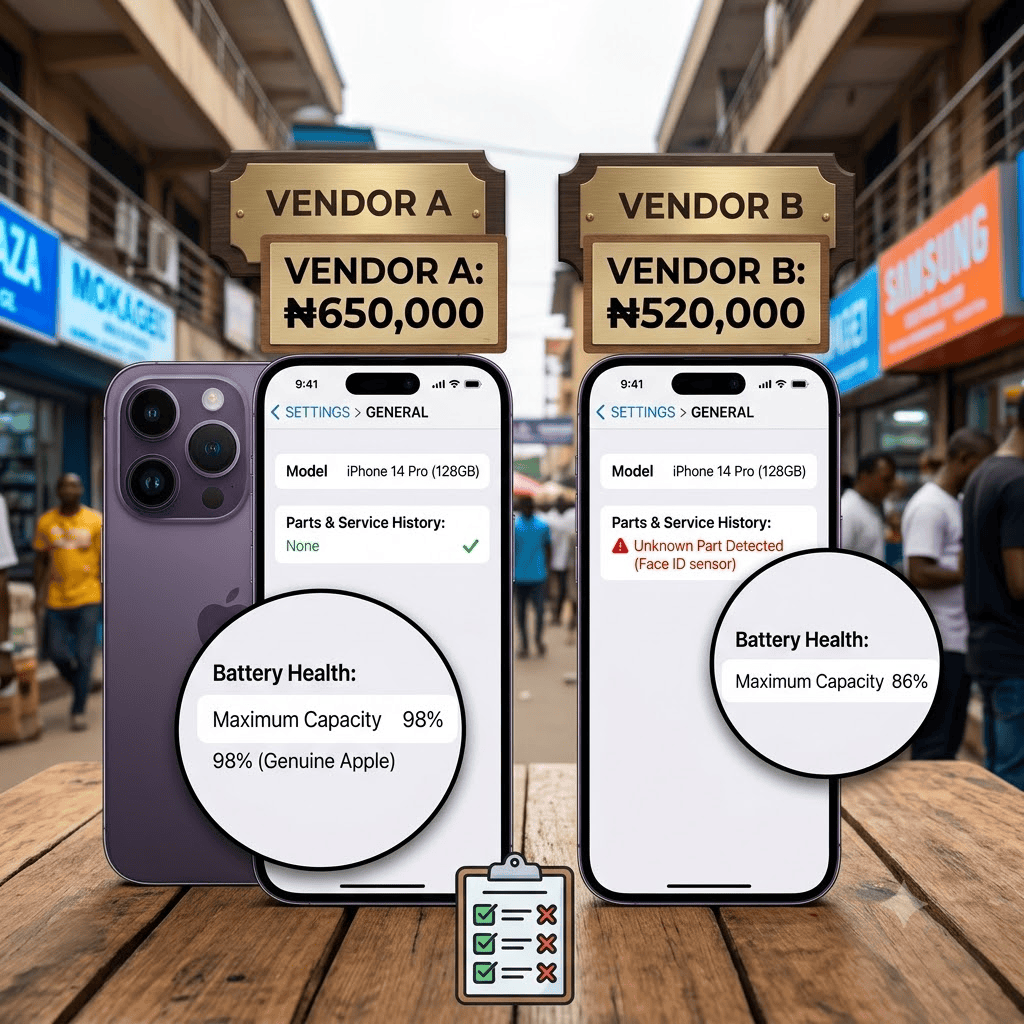
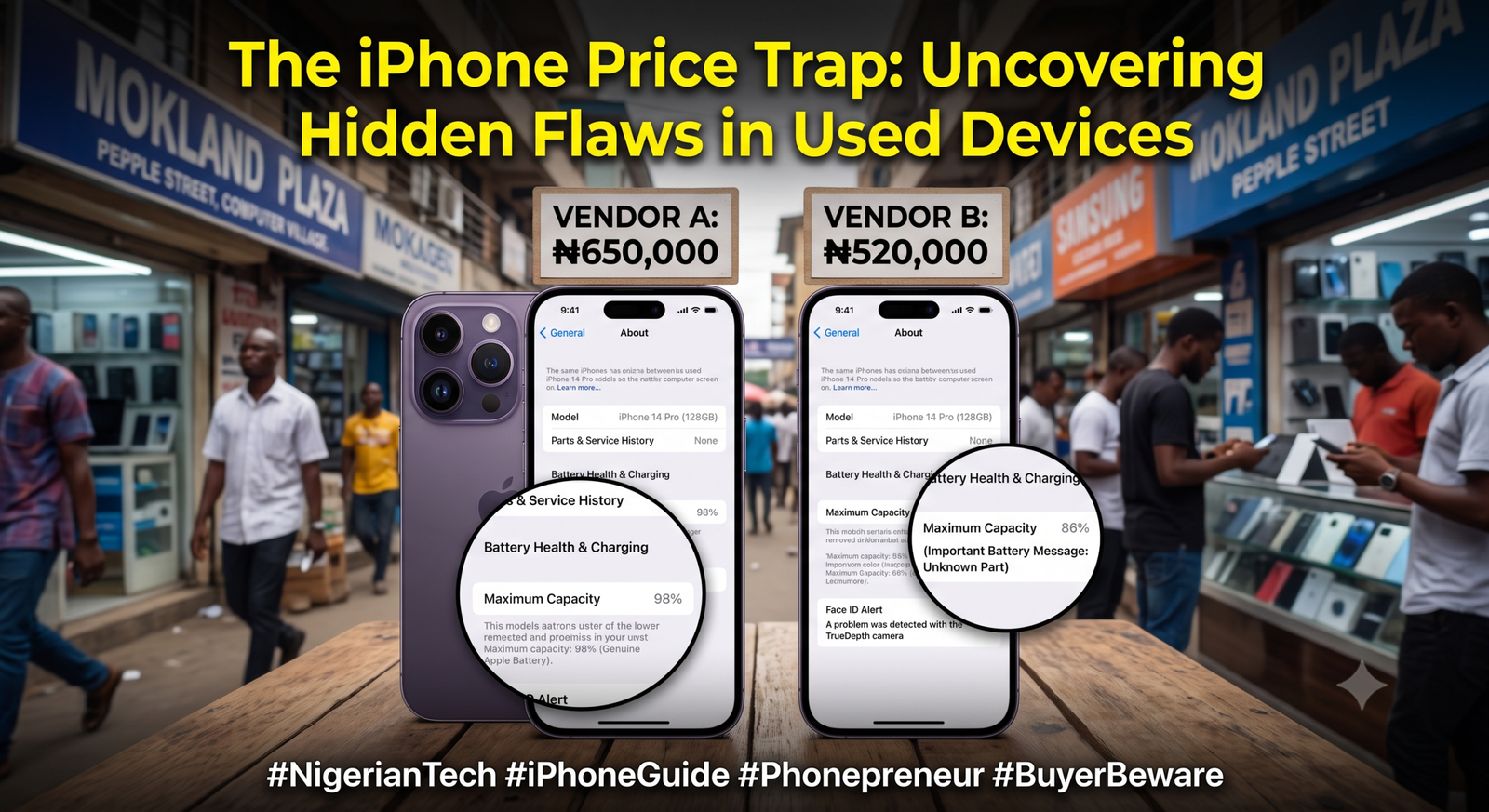
Imagine you’re walking down Pepple Street in Computer Village, or scrolling through your Instagram feed, and you see two identical listings. Both are deep purple iPhone 14 Pro models. Both have 128GB of storage. Yet, Vendor A is selling theirs for ₦650,000, while Vendor B is listing theirs for ₦520,000.
A massive ₦130,000 difference for the exact same phone!
Instantly, your brain tells you to grab the cheaper one before someone else does. But in the Nigerian gadget market, if a deal looks too good to be true, it almost always is.
Today, we’re putting on our detective hats to uncover exactly why some iPhones are priced so low, what the sellers aren’t telling you, and how you can spot the hidden traps before spending your hard-earned Naira.
The Real Reasons Behind iPhone Price Variances
1. iPhone Storage Differs
This is the most straightforward factor, yet many buyers overlook it when comparing prices across different vendors. An iPhone’s price scales up significantly with its storage capacity. A 512GB model will always command a much higher price tag than a 128GB version. Always double-check that you aren’t comparing a base-model price against a high-storage price.
2. There’s the Cosmetic & Physical Condition Grading
In the UK-used and pre-owned smartphone market, devices are heavily graded based on their physical appearance:
Grade A (Pristine): Zero scratches, flawless frame, looks brand new.
Grade B (Lightly Used): Minor pocket scratches, tiny scuffs along the aluminum or stainless steel borders.
Grade C (Heavily Used): Noticeable dents on the corners, deep scratches on the back glass, or tiny micro-cracks near the camera housing.
A Grade C phone might function perfectly internally, but its cosmetic flaws cause its market price to plummet.
3. The Battery Health Trap
Battery health is a primary price determinant in Nigeria. A device with 98% battery health will naturally cost more than one sitting at 81%, as the latter is nearing the threshold where iOS will recommend a service upgrade.
However, remember what we always say at The Phonepreneur: Beware of artificially “boosted” 100% battery health on poorly refurbished units. Authentic, untouched 86% health is infinitely better than a manipulated 100%.
4. Bypassed or Disabled Face ID
If an iPhone is remarkably cheap, there is a very high probability that Face ID is permanently broken. Repairing the TrueDepth camera system is an incredibly intricate and expensive procedure. Sellers often slash their prices significantly to quickly offload phones with dead Face ID sensors.
5. Hidden Repair History & Non-Genuine Parts
This is where unsuspecting buyers get burnt the most. Why is that iPhone so cheap? Because someone might have swapped out the original, vibrant Apple OLED screen for a cheap, third-party LCD replacement panel that drains your battery and lacks True Tone functionality. Or perhaps the camera modules were harvested and replaced with inferior, blurry aftermarket parts.
6. Market Forces Can Affect
Sometimes, price differences come down to timing and logistics. A vendor who imported their inventory when the Naira-to-Dollar exchange rate fluctuated downward can afford to sell their stock slightly cheaper than a vendor who bought their inventory at peak parallel-market rates.
The Smart Buyer’s Inspection Checklist
Before you ever hand over cash or make a bank transfer for a pre-owned iPhone, run it through The Phonepreneur Checklist:
[ ] Battery Verification: Is the battery health original or has it been artificially altered?
[ ] Biometrics Test: Does Face ID register your face quickly and unlock from multiple angles?
[ ] Component Authenticity: Go to Settings > General > About to see if iOS flags any “Unknown Parts” (for iOS 15.2 and later).
[ ] True Tone Activation: Is True Tone available in your display settings? (Its absence usually indicates a swapped screen).
[ ] Enclosure Inspection: Are there deep corner dents indicating severe drops that could have fractured internal layers of the motherboard?
[ ] The Transparency Test: Does the vendor offer a valid store receipt, a testing window, and a clear after-sales warranty?
Also Read: 10 Mistakes Nigerians Make When Buying an iPhone
Important!
Price only tells you how much money leaves your pocket today. Condition and authenticity tell you how much money you will spend fixing it tomorrow. The smartest tech buyers don’t just ask, “How much is it?” They ask, “Why does it cost this specific amount?”
Buying a premium smartphone shouldn’t feel like a high-stakes gamble. If you ever feel confused or want a completely transparent breakdown of a device’s history, condition, and value, walk into our stores or send us a message. We’ll always give you the absolute truth: no hidden catches, no compromises.
Get in Touch With Us
At The Phonepreneur, we make it incredibly easy to level up your mobile experience. We sell, we swap, we repair, and we deliver nationwide! If you prefer a hands-on experience, you can also opt for physical pick-up at our locations.
Drop by Our Walk-In Stores in Lagos
Don’t wait until your current phone gives up entirely. We welcome serious buyers to visit our physical walk-in stores in Lagos for instant swaps, expert repairs, or to browse our latest premium inventory:
Shop 1: 2 Pepple Street, Mokland Plaza, 1st Floor Right Wing, Opp. Zenith Bank, Computer Village, Ikeja, Lagos.
Shop 2: Shop 4C, 4th Floor, Mokland Plaza, 3–9 Olu Koleosho Street, Off Simbiat Abiola Road, Computer Village, Ikeja, Lagos. (Landmark: Mokland Hotel; street opposite New Slot, Medical Road).
Reach Our Team Instantly
Have questions about a phone swap, need a quick screen repair before the next big game, or want to lock in a new device? Reach out now:
Call / WhatsApp: 08106360694 | 08146321691
Instagram: @the_phonepreneur
TikTok: @thephonepreneur
Discover more from The Phonepreneur Global
Subscribe to get the latest posts sent to your email.